|
History has shown that stocks are simply the best investment medium to secure
your financial well-being. Simply, no financial investment does better than stocks.
For the period 1995 and 1996, the U.S. stockmarket has produced cumulative returns
of nearly 70%, a reason for many stock investors to cheer. The soaring KLSE in 1993
and positive performance last year had most investors smiling all the way to the
banks.
Feeling adventurous enough to make a big swing in the stockmarket? If you had invested
in the KLSE somewhere around April, you would probably have a very good reason not
to cheer.
Losing some money in any stockmarket is inevitable. You cannot be right on the market
all the time. Like people, stockmarkets have both good and bad times. Despite all
the hiccups in short periods, stocks remain as key investments for most people.
Various studies support the fact that stocks have almost always outperformed other
instruments over the longer term. Let us examine some selected historical studies
conducted to show the performance of the U.S. stocks to see if this view is supported.
The U.S. stocks, a reflection of a matured and fundamental-driven financial environment
would be our preferred choice for illustration.
Over 10-year periods, stocks in the U.S. have almost always outperformed bonds leaving
bank accounts in the dark The most widely cited Ibbotson study in Table 1 shows that
stocks in the U.S. historically perform better than other selected instruments over
the long-term.
Note also among different instruments, stocks have the highest risk as measured by
standard deviation but if you invest for long term, you will likely see a smoother
curve on the horizon - forget short-term volatility.
Table 1. Summary Statistics of Annual Returns (1926-1990)
|
Series
|
Compounded annual rate of return (%)
|
Average yearly rates of return (%)
|
Standard Deviation
(%)
|
| Common stocks |
10.1
|
12.1
|
20.8
|
| Small company stocks |
11.6
|
17.1
|
35.4
|
| Long-term corporate bonds |
5.2
|
5.5
|
8.4
|
| Long-term govt. bonds |
4.5
|
4.9
|
8.5
|
| Intermediate govt. bonds |
5.0
|
5.1
|
5.5
|
| U.S. Treasury bills |
3.7
|
3.7
|
3.4
|
| Inflation |
3.1
|
3.2
|
4.7
|
Source: SBBI 1991, Yearbook.
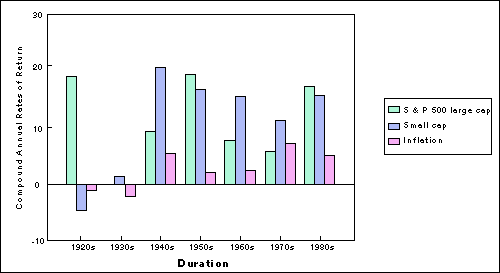
In addition, table 2 shows the stocks compound annual rates over the decades generally
outpaced inflation. Remarkably, large stocks (S&P 500) outperformed inflation
by nearly 12.4% in the 1980s.
Table 2. Compound Annual Rates for Decades
Source: SBBI 1991, Yearbook.
|