|

Bonds are basically simple instruments. It is a paper issued by the issuer who is
the debtor to the bondholder. The bondholder receives fixed-income returns in the
form of interest payments prior to the specified maturity date.
The bondholder receives the principal value when the bonds mature. Different bonds
have different maturity dates. In short, there are four basic features of bonds,
that is yield to maturity, coupon payment, face (principal) value and maturity date.
Investing in bonds is not entirely without risk or "risk-free" as most
investors would assume. To simplify things, we highlight only three risk factors
here. Firstly, interest rate risk. Bond prices move inversely with interest rates
changes - when interest rates fall, bond prices go up and vice-versa. There is potential
for capital appreciation when interest rates drop.
Secondly, credit risk. The possibility that the issuer will default his/her
obligation in making interest and principal payment. Investors often refer to the
issuers credit rating when evaluating bonds.
Thirdly, purchasing power risk. The impact of inflation shrinks your purchasing
power. Like fixed deposit rates, the returns that you receive from your interest
may be eaten up by rising inflation.
If you are thinking of putting your money in bonds to balance your portfolio or to
smooth out stock volatility, an easier way would be to invest in bond funds. Unlike
most unit trust funds that invest mainly in stocks, bond funds invest in fixed-income
securities listed on the KLSE, corporate bonds traded in the money market, Malaysian
Government securities, treasury bills, foreign fixed-income securities/bonds, Malaysian
currency deposits, Cagamas bonds and bankers' acceptances.
One must remember that the exciting world of investments does not end with stocks.
Even though they usually underperform stocks in terms of returns, they provide an
avenue for diversification. In fact, from 1985 to 1995, long-term U.S. government
bonds actually outpaced small-company stocks. Inclusion of bonds in your portfolio
can smooth out volatility.
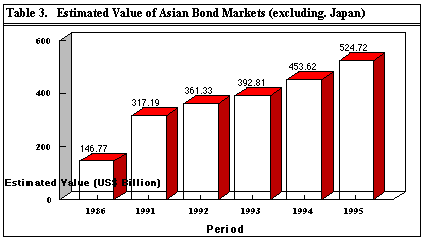
Unlike stocks, bond investments are generally not very popular among Asian investors.
Nevertheless, in a matter of few years, it will be no surprise if the total value
of Asia's bond markets grow match the total capitalization of the region's stockmarkets.
Table 3 shows the growing Asian bond markets (source: HSBC Capital Markets).
In Malaysia, bond investments are expected to increase in popularity in the coming
years as the market progresses.

Review your asset allocation if necessary. Learn how bonds can help you diversify.
It is also important for you to look long-term. As we have repeatedly stressed, short-term
gains will not secure your financial well-being.
The local stockmarket is not likely to glitter like in 1996 for the remainder of
the year. You should do something - learn from your mistake and start to diversify.
Remember the famous old saying "do not put all your eggs in one basket".


|