|
Malaysia's rapid-changing economic landscape is gradually turning the local financial
market into a more matured and sophisticated marketplace.
Although short-to-medium term uncertainties still linger on investors' minds, signs
still point to long-term prosperity in Malaysia. Despite the recent rocking of both
the currency and stocks, individual investors should look ahead and continue to grow
their money.
Rather than overreacting, investors should instead focus more to the specific characteristics
of certain companies and long-term fundamentals of the economy.
Investors should begin to pick up some stocks selectively for their portfolios with
a 3-5 year time frame given the current attractive valuations and sound fundamentals.
For individual investors who wish to manage their own money, care is required if
they intend to invest in stocks. In searching for potential companies to invest in,
various details need to be considered such as quality of earnings, earnings track
records, strength of the management company, dividend growth, position in the specific
industry, cashflow, profit margin, just to name a few.
Financial analysts use a wide range of key ratios when valuing companies. In other
words, you should be familiar with the fundamental aspects of investments. Issues
such as price/earnings ratio or price/book value ratio should be the main consideration.
Your decision to invest should not be overwhelmed by market speculation which is
part and parcel of any investment market.
On top of that, reliable and quick information is a necessity. Your work will be
likely distorted if you are unable to locate accurate sources of information.
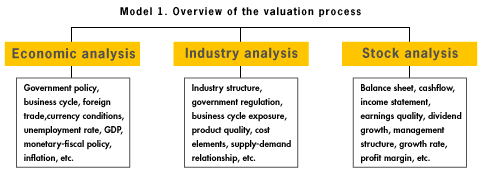
Valuation is often based on economic and industry variables plus an in-depth analysis
of the stocks prospects (refer to model 1). In general, analysts use various valuation
models in order to identify undervalued stock prices. Different people will have
different ways of picking stocks.
For your investment strategy, you may select either bottom-up or top-down approach.
Bottom-up approach focuses on stock-specific selection. It concentrates primarily
on specific companies rather than markets or specific sectors.
Top down approach primarily emphasizes economic and industrial analysis - factors
such as currency conditions, business cycles, competition, government policies, etc
can swing stock prices (Refer to model 2).

|