|
This article is reproduced with
permission from |
 |
The Good News
The Bad News
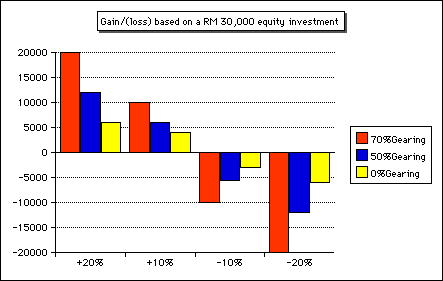
In 1994, we saw many examples of borrowing to invest going wrong when share and unit trust prices fell. In comparison, if Mr.Investor had used only cash for the purchase of RM8,800 worth of stocks, he would have enjoyed a 50% return on his initial investment if the portfolio value doubles to RM24,000. Favourable financial leverage magnified the 50% gain into a 80% return. However, should there be bad news whereby the share price drops by 50%, the adverse financial leverage magnified the 50% drop into a 102% decline in equity. Mr.Investor can expect to receive a "margin call" soon. This means that Mr. Investor will need to pay up extra money to bring the lending ratio back to 45% or selling some of the shares, possibly at a loss. One point investors should be aware of is the "buffer" which is commonly practiced. A buffer is the margin the stockbroking company as a lender builds in to protect itself and the investor's portfolio. How this works is if a company says it will let you borrow 70% of the value of a portfolio, the investor will not be alerted of a margin until the loan-to-valuation ratio reaches 75% for a 5% buffer zone. The advantages and disadvantages of borrowing to invest are summarised in Table 1:
All investors should be aware that there are dangers in this financing facility because the share market is traditionally more volatile than property markets. This is caused partly by fluctuations in the daily share trading whereas there is less daily fluctuations in house prices because a house is not traded every day. Another danger is the companies which funds are invested in are already having debt in their balance sheets which can make their profits and share prices sensitive to interest rate changes. Because companies structure themselves for growth by their own debt levels, this increases the investor's own risk of financial success or failure. Therefore it is not a bad idea to glance at the debt/equity ratio of the shares you are borrowing to buy. For a risk adverse person or the faint-hearted, a geared investment would be too risky. Margin financing may have its downside risks but borrowing to invest is best for long term investors looking to create long term wealth. It is advisable investors should not be borrowing money for the short term unless they are absolutely certain the investment will perform above borrowing costs and in reality one cannot be sure of that. Hence investors with a long term investment horizon should put in enough money or security to avoid a margin call because margin calls usually happen at a time when people are nervous and do not have the cash. Any geared investor who becomes retrenched or experiences a curtailment of income due to sickness has potential problems in terms of winding up a geared investment plan in the early stages. This is because of the volatile nature of the share market which can reduce the value of the portfolio.
|
|||||||||||||||||||