|

Buying shares in a company is a popular method of investment. What determines the
price of a stock? Everyone commonly wishes to own stocks which are fundamentally
sound and can deliver long-term capital appreciation. However, there are some investors
who are driven by greed rather than knowledge punt heavily in the stockmarket hoping
to reap significant rewards in a very short-time.
These are the same people who gambled and made a fortune for themselves when the
market turned bullish but eventually losing more than what they now own when the
market collapsed.
As our market develops, local investors will naturally become more mature and start
to look at various fundamentals to justify their buying and not merely react to unfounded
rumors or tips. The key to successful stock investing is that decisions to buy should
be supported by adequate research.
In developed markets, investors react to fundamental developments such as changes
in the management of companies, interest rates, etc. Stocks go up and down reflecting
release of corporate earnings, news of acquisitions or mergers, changes in economic
trends, political developments, etc.

Before you buy a stock, you should have some basic awareness of the company's financial
standing and management policies so that you can better estimate the companyís future
prospects more effectively.
The best way to start is by looking at the company's annual report. It allows you
to gain a simple insight about the financial health of the company. Overall, it allows
you to get a sense of the company's mission, its products, its attitude and its prospects.
The very first item you notice in an annual report is the gloss - attractive layouts,
colorful photos, jazzy charts and bar charts.
You can enjoy the glossies but do not be simply overwhelmed by them. Focus on the
real numbers and performance instead. Annual reports show the sales, costs, earnings
per share and many other important figures.
You will more likely favor a company which shows strong and consistent earnings growth
than one with inferior earnings. Blue chip are companies which have a very solid
steady stream of earnings and have more stable stock prices as compared to other
stocks.
Annual reports are helpful for potential investors who want to get a quick overview
of the overall company's picture. Observe the three main items in the annual report.
| The Balance Sheet - |
A financial statement that indicates what the firm owns (assets) and how these assets
are financed in the form of liabilities and the ownership interest at a given point. |
| Income Statement - |
Provides information on the sales, costs and profits during the specified time. It
is a financial statement that shows the profitability of a firm over a given period
- reflecting how effectively a company manages its income and expenses. This commonly
referred to as the Profit and Loss statement. |
| Cash-flow Statement - |
Financial statement combining information provided in balance sheet and income statement
to report cash inflows and outflows. The purpose of a cash-flow statement is to illustrate
the movement of the cash and how the business is financed. |
You may ask how reliable are financial figures published by companies. Do the figures
actually reveal the true financial position of the companies? To this extent, you
have to rely on statement of the auditor included in the account. Every annual report
is audited to confirm the validity of the numbers.
The way the figures are presented however may not totally reflect a company's future
performance. A company which has poor historical earnings might experience a turnaround
in the near future due to take-over by a more capable management team. On the other
hand, a company with good past profits may go down due to stiffer competition and
other relevant depressing factors such as strikes, damaging lawsuits, natural disasters,
etc.
Investors may also study various financial ratios of companies as part of their studies.
Key ratios such as the profitability and liquidity ratios can tell a lot about a
companyís position.
In short, the company's financial picture is important in order to make the right
investment decisions. If you are investing to build your long-term wealth, you must
know what you are buying. The analogy being you do not buy a car without lifting
the bonnet to see if the engine is there. A wise investor does not buy stocks based
on pure rumours.
Clearly, you will favor companies with sound future prospects. While history can
be a useful guide, investors should be careful not to jump into conclusions by just
looking at historical figures.

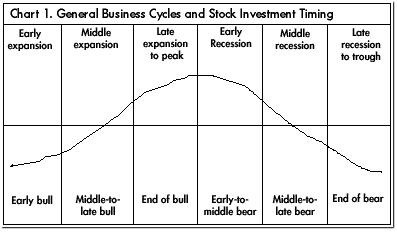
Looking at the company alone is not enough as they are also affected by the industry
as a whole. Many industries expand and contract in the business cycles. In any business
cycle, a trough represents the end of a recession and a peak represents in end of
an expansion and the beginning of a recession. Refer to chart 1 for a complete business
cycle and investment timing for stocks.
Generally, if a particular industry is slowing due to some economic factors, the
companyís performance will likely be affected causing the stock price to fall. For
example, during periods of high interest rates, the property sector is unlikely to
perform well.
Source: Normandy Research
|