|
|

It should be noted that indexing is only for long-term. It should not be used
for short-term trading typically practiced by local investors hoping to reap instant
rewards. Stocks especially blue chips tend to grow over the long-term, indexing usually
produces results over the long-term.
Stocks with sound fundamentals will grow in value over the long-term despite short-term
setbacks. For long-term investors, one or two years performance should not be used
as a yardstick for performance analysis.

Index funds are mutual investments such as unit trust or unit-linked life funds
which invest in the constituent elements of a market index. The funds are designed
to perform in line with that index benchmark. The return from pure indexing is capped
by the performance of the market it emulates. Index funds generally hold little or
no cash.
During a market downtrend, they usually decline more than general funds. In such
instances, the large proportion of cash held by general stock funds helps to cushion
the market fall.
In some cases the index funds match the performance of the entire stockmarket. There
are also funds which are not pure index funds. Generally, a full replication of the
index reduces the risk that the fund will perform differently from the specific index.
If we take into account expenses, index funds will not reflect the real market standard.
Properly managed index funds should perform slightly under the benchmark due to fees
and expenses.
However, most index funds have lower expenses than general stock funds due to its
passive fund management style which does not involve regular periodic changes to
a portfolio.

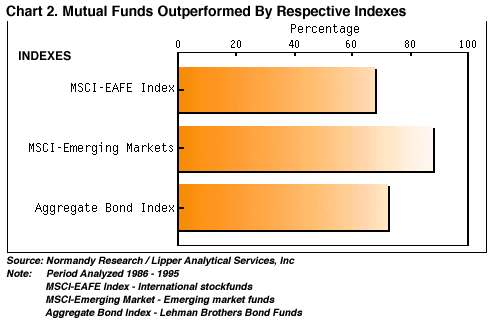
Indexing is not limited to local benchmarks. It is also possible to track international
indexes and the concept works for many types of investments including bonds. Chart
2 shows the percentage of funds in various categories outperformed by their respective
benchmarks. The return for each index has been reduced accordingly to reflect approximate
index fund costs

Locally, the growth of index funds lags significantly behind the matured markets
despite the fact that indexing is an investment strategy that has been tested overtime.
As personal investors and financial markets grow to become more matured - fundamental-driven,
more individual investors will likely consider this form of investing.
Currently in Malaysia, there are few unit trust funds which closely track the performance
of the stockmarket benchmark. Given the commendable performance of index funds elsewhere,
it should not be too long before more of such funds are introduced. Investors are
constantly looking out for good investment opportunities.
As they become more conscious on the benefits of index investing, it would be natural
for them to expect to have the option to include index funds as part of their financial
planning.


|