|
|
Albert Einstein is reputed to have called compound interest "the most powerful
force in the universe". Benjamin Franklin said a man has three great friends:
an old wife, an old dog, and compound interest. The fiscally prudent Benjamin established
an investment fund in Boston with about US$4,000 back in 1789.
Though not a rich man, he fully understood the majesty of compound interest. By 1991,
the fund was worth more than US$4 million - compound interest worked its magic over
the years. Why are so many great investors impressed by the "magic of compounding?".
Everyone knows that putting a little money away on a regular basis is a smart way
to reach your financial objectives, be it buying a house, sending a child to college,
or enjoying your retirement.
Nevertheless, many fail to recognize the effects of compound interest and appreciate
how it actually works. Compounding is a general term for values that accumulate,
whereby increments are calculated on accumulated rather than base values. When you
invest your money, say in fixed deposit, the interest is the payment separate from
the amount you "originally" invested (principal). If the interest is compounded,
it means that the interest is not taken out but allowed to accumulate on top of the
principal.

What is the difference between a compound interest and simple interest? In simple
interest, the interest is derived only from the principal sum. If we have RM100 and
invest the amount for one year at the interest rate of 6%, at the end of the year,
the interest gained is RM6.00. In the simple interest, the RM6.00 is not summed together
with the principal. But what happen if the interest is not taken out?

In the this case, the interest is compounded. Any interest which is not paid
out will continue to build up. In the above example, we will have RM106 (RM100 principal
plus 6% interest). The entire amount of RM106 will earn 6% interest for the second
year. At the end of the second year, you will have RM112.36 (principal RM106 and
interest RM6.36).
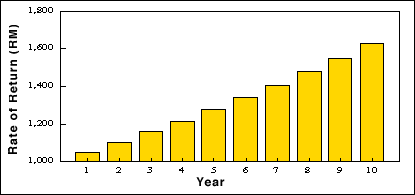
In another simple example, if you invest RM1,000 in Fund A and if it yields 5% interest
per year, you will receive RM50 in the first year. If you reinvest the RM50, you
will receive an additional RM2.50 in the following year from the RM50 that is reinvested.
You reinvest all the returns and the total value of your investment after ten years
would be equal to RM1,629.
Notice that you not only receive 50% over the period (5% x 10 years). The power of
compounding gives you a return of 63% return. The compound interest, as Benjamin
Franklin puts it, is indeed one of man's great friends. The basic of compounding
effect can be illustrated as follows:
RM1,000 x 1.05 x 1.05 x 1.05 x 1.05
x 1.05 x 1.05 x 1.05 x 1.05 x 1.05 x 1.05 = RM1,629
or
RM1,000 x (1.05)10 = RM1,629
| |
Y1
|
Y2
|
Y2
|
Y4
|
Y5
|
Y6
|
Y7
|
Y8
|
Y9
|
Y10
|
|
Principal
|
1,000
|
1,050
|
1,103
|
1,158
|
1,216
|
1,277
|
1,341
|
1,408
|
1,478
|
1,552
|
|
5% p.a
|
50
|
53
|
55
|
58
|
61
|
64
|
67
|
70
|
74
|
76
|
|
Total
|
1,050
|
1,103
|
1,158
|
1,216
|
1,277
|
1,341
|
1,408
|
1,478
|
1,552
|
1,629
|
Note: Figures have been rounded up
Amount in Ringgit
Chart 1. How compound interest works
"One of the most central and powerful concepts in finance and investments
is compound interest. It works with a "snowball" effect. The longer you
save or invest, the more compounding can benefit you".

|