This is the website dedicated to the original Canon EOS-1 camera. You must have strong reasons to have enter this site. They could be any of the following:
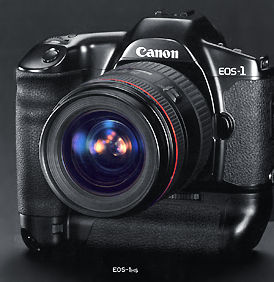 |
1) You are currently a user of Canon's manual series of SLR cameras like the Canon T90 or the Canon New F-1 and finally decided you would like to make the switch to over to the Canon EOS System. |
5) Other reasons or excuses for continuing
to use the original EOS-1 and resist the temptations of upgrading into any improved
versions.
6) All of the above
If yes, you have come to the right place. In this website, you will be able to learn more about your favorite EOS-1 camera and its performances in the real world. For example, the EOS-1 was designed to operate flawlessly even under extreme conditions but you may have come across comments from some irresponsible people (non Canon EOS users) that have belittled such claims as well as other nonsenses. As any EOS-1 user already know, the Canon EOS-1 is a camera that combines total automatic operations with sophisticated manual control and ease-of-use. But there are also a lot of users who may feel a bit inferior that by continuing to use the EOS-1when others had already traded-in theirs for the new EOS-1N or EOS-1N RS cameras.
The EOS-1N is no doubt an improvement over the original EOS-1but the latter is still no slouch when it comes to handling and performances. It can easily put most of rivaling camera models from those of Nikon, Minolta and the Pentaxes' arsenal of high-tech AF SLRs to shame! Come to think of it, you wouldn't find any pre-1994 AF SLRs from competing models to be able to match the EOS-1's sophisticated AF system, either. Yes, it is true that certain pre-1994 emerging AF SLR camera models have wide area or multi-point AF system but in real use (meaning actual assignments), these cameras can't match the EOS-1's AF system in covering sporting actions. How many sports photographers can one find that used Minolta bodies at any major sporting events prior to the debut of the Canon EOS-1N version in September 1994?
As Canon itself had stated from the EOS-1's original brochure via the opening few pages where it reads: ".... In the accelerating evolution of modern camera technology, even minor improvements seem like major events. But now there truly is a major event. The new Canon EOS-1. Created to meet the needs of the most demanding professional and advanced amateur photographers. And to become the classical standard against which all others must be measured ....".
Yes, the EOS-1was indeed designed especially for the professional photographers but that does not mean that if you can't use the camera if you happens to be an advanced amateur or simply a beginner with plenty of money to invest in one. The main reason for choosing a 35mm EOS camera is its ultra fast and highly responsive autofocus system. The AF system will be the first among the EOS-1's list of features this website will focus on.
The EOS-1 has a single AF point located at the centre of the viewfinder frame for its AF capability. A single AF point may be somewhat outdated by now but it was the norm when the EOS-1 was introduced to the world back in 1989. Still, the single AF point has an AF sensitivity range of down to EV minus 1, which is far more responsive than any EOS cameras (except for the EOS-1N RS) currently available, including its successor, the EOS-1N or the new EOS-3 camera.
One familiar sight nowadays at all the major sporting events is the number of white-coloured telephoto lenses as used by the professional sports photographers covering such events. Such cameras used to be the original EOS-1 but are currently dominated by both of its two successors, the EOS-1N and RS cameras.
Nevertheless, the point above is not about whether the professional photographers were using the original EOS-1 or its two successors but the Canon EOS System. And the main reason they chose the Canon EOS system is due to the ultra fast AF feature.
Of course, some of you may have read from elsewhere or in photo magazines where certain sports photographers had claimed that they NEVER used the EOS-1's AF feature at all, preferring to manually focus the lenses. Some had even claimed that the reason for choosing the EOS System was due to the wide selections of the Canon EF lenses available.
All these claims are baseless. Up to 1992, the range and types of EF lenses available were still below the range available from Canon's discontinued manual focus FD lenses for the A-series, T-series and F-series of 35mm SLR cameras. They don't even need to have invest in the EOS-1 camera if indeed it was the range of EF lenses that had impressed them previously since the Canon T90 and FD lenses combination would have performed similarly as an EOS-1 and EF lenses combination if only manual focusing is what they needed.
Most professional photographers are still shy about admitting to having used autofocus in their daily assignments. From our own research conducted here in Malaysia during the hosting of several international sporting and high-profile government (news) events, where the majority of the professional photographers are using the Canon EOS System, we found that about 99% of them never leave the AF/Manual switch of their respective EF lenses in the manual focusing position.
Of course, it can be argued that most EF USM lenses allows full-time manual focusing capability even when the focus selector switch of the lenses is still in the AF position but we noticed that the left hands of these photographers were either used for turning the zooming ring (EF zoom lenses) or holding the front end of the lens barrel (EF telephoto lenses) but were never placed on the focusing rings.
This is what the Canon EOS-1 provides so brilliantly not only with its AF system but also with full automation needed for the tasks that are tangential to the creative process of making photographs. That, is the main REASON why these professional photographers chose the Canon EOS System. And the EOS-1 camera or any of its two successor models.
Now back to the EOS-1 camera and its AF system. You may have distrust autofocus technology, previously. You may not see why you need it, for one thing. And you may have run into other systems that were inadequate. Since you have already read this far, the previous few lines of this paragraph are no longer applicable if you are already is a proud user of the Canon EOS-1 camera.
==========================================================
You use the automation
the way you want, when you want it, and when you needed it.
The EOS-I has been designed to provide you, regardless of whether you are a professional
photographer, a serious amateur or hobbyist shooter, with total control over every
photographic situation you might encounter. This means going beyond automation to
a totally integrated system that permits the "fine-tuning" of various key
aspects of the photographic process. That which is merely incidental to the act of
making photographs ó film advance, film rewind, etc.óis fully automated.
In order to create a camera good enough
to meet any photographic situation, Canon decided it was necessary to reach beyond
even the most sophisticated automatic operation and had devised a new form of manual
operation via the proven and patented Quick Control Dial that takes advantage of
the advanced technology to work faster and with more precision than ever before possible.
Essential options for personalized operation like the Custom Functions Control, let
you "design" the camera to fit your demands, whatever the occasion.
The EOS-1is the first camera to incorporate two electronic input dials. The front
main dial was inherited from the Canon T90 camera while the afore mentioned Quick
Control Dial made its debut with the EOS-1 camera and proved to be a hit with users
and critics alike. The Quick Control Dial was even featured in a few of the amateur
EOS models like the discontinued EOS 100 (EOS Elan), EOS 50/50E EOS Elan II/IIe),
EOS 5 (A2/A2E) as well as the new EOS-3.
As mentioned earlier, an EOS-1 camera fitted with any EF lenses and used exclusively for manual focusing is not much different from using a Canon T90 camera fitted with any Canon FD lenses. The T90 is the basis for the EOS cameras. In fact, most EOS cameras from the first EOS 650 model up to the latest EOS-3 version has one or two things that are inherited from the T90.
When the T90 made its debut back in 1986, it took the 35mm camera industry by storm. What was perceived as impossible has been made possible by Canon with the T90. It was an excellent camera with all its outstanding features but being a manual focus camera, it has already reached its limits to how far camera technology can go with the older, mechanical linkage version of the popular FD lenses system.
Thus, the EOS System was born, inherited with it was the proven formula used in the T90 camera in addition to the unlimited potentials of advanced camera technologies being expanded and further developed with the new, fully electronic EF lens mount of the EOS System, which has no mechanical linkage whatsoever between the lenses and the camera body.
The benefits of the fully electronic
lens mount of the EOS System? The first EOS, the 650, was launched back in 1987.
It is 1999 now. Any older non-USM EF lenses that also made their debut with the EOS
650 camera can be fitted to all entry-level and amateur EOS models as well as the
EOS-1, EOS-1N, EOS-1N RS and the new EOS-3 cameras without loss of features,
metering options or shooting modes. Try doing that with all the other AF 35mm SLR
camera systems.
Like the T90, the main dial of the EOS-1works in combination with various mode selectors
to allow the photographer to quickly dial in operational choices. It selects the
exposure control, AF operation and metering pattern. It also selects shutter speeds
or aperture values during shutter-priority AE or aperture-priority AE operation.
It also enabled the user to alter the exposure settings in the Program AE mode if
the user wished to select a faster or slower shutter speeds or smaller or larger
aperture values than what the camera has set. It is also used to set the auto exposure
bracketing values and exposure compensation when the respective buttons for these
functions are pressed. The film winding speed, number of multiple exposure presets,
and manual film speed settings are also set by the main dial as well as the selections
of the EOS-l's unique Custom Function Controls.
Meanwhile, the Quick Control Dial has a switch that enables operation. In the manual
exposure mode, this dial can be used to manually set aperture value or shutter speedódepending
on the custom function selectedó with the main dial setting the other value. In the
AE mode, the quick control dial can be used to set exposure compensation values.
Listing the options above gives you a sense of the total control offered by the EOS-1.
But only by handling the camera and actually using the two dials can you appreciate
just how simple and convenient they are to operate, since they quickly become intuitiveóparticularly
in the metered manual shooting mode, with each input selection instantly confirmed
in the viewfinder's exposure level scale.
LCD Display Panel
Just as the two electronic input dials enable quick, effortless decision-making,
the EOS-1's LCD display panel lets you quickly check operating conditions. The LCD
display panel has been inclined toward the rear slightly for better readability and
is equipped with an integrated electro-luminescence function that makes it easy to
see in the dark.
Viewfinder and information
display
The bright, 20mm High-Eyepoint viewfinder has a field of view that is virtually 100
%, ensuring that you see exactly what you are photographing. The viewfinder employs
a fixed pentaprism and has seven types of interchangeable focusing screens. A built-in
integrated dioptric adjustment function from - 3 to + I allows compensation for photographers
who wear glasses. Users of the Canon New F-1 has griped that the EOS-1 does not come
with an interchangeable viewfinder system. The reason Canon has not adopted this
feature for the EOS-1 is because by doing away with the removable viewfinder feature,
the EOS-1 can offer better protection and sealing against the moisture and dust.
And we think that the move by Canon is right. After all, how many users of the New
F-1 or for that matter, users of the Nikon F3, F4 or the F5 cameras really do change
the standard viewfinder they bought their respective cameras with any of the optional
types available?
Basic information is displayed along the bottom and at the side of the viewfinder.
Information along the bottom includes manual exposure indicator, AE lock, shutter
speed or aperture value, depth-of-fleld AE indicators, exposure compensation indicator,
flash charge completion and AF confirmation. Along the side are a detailed exposure
level scale with overexposure and underexposure indicators. Exposure values are displayed
with dots in I /3-step increments. When using AE lock, the difference between the
locked value and actual value is indicated. Below this scale is a frame counter that
shows the number of frames remaining. The gripes we have with the EOS-1's viewfinder
system, which are also inherited by the two successor models, are the lack of signs
for which metering options or shooting modes (except for Manual mode) the camera
is in.
Depth-of-field preview
Depth-of-field preview provides a visual confirmation of the zone of focus. With
only a touch of a button located at the lower right of the EOS-1 near the lens mount,
you can easily preview the scene in any exposure mode, thanks to the EMD (Electro-Magnetic
Drive) which achieves precise control. This capability is another feature made possible
with the EOS System's fully electronic EF lens mount.
Metered Manual Control
The two electronic input dials make metered manual operation exceptionally easy and
precise. In this mode, the shutter speed is set using the main dial while the aperture
is set by the quick control dial. These values are displayed digitally in the viewfinder.
And the metered manual exposure's deviation from the correct exposure indicator is
clearly indicated by the moving marker on the exposure scale in the viewfinder for
instant confirmation. The "matching-needle" feel of the system has a mechanical
sense that is reliable and reassuring. Canon's "new" metered manual, together
with body-integral auto bracketing and I /3-stop precision are a dream come true
for the pro shooting transparency films.
Manual focus
All the Canon EF lenses currently available have a switch on the lens barrel that
lets you shift from AF to manual operation. There were, however, two EF zoom lenses
that only offered autofocus without manual focus override. These two lenses were
made especially for the entry-level EOS 750 and 850 models which were launched back
in 1988 and discontinued a year later. The manual focusing "feel" is pleasingly
smooth, without the rasping operation common to some AF lenses, although the focusing
rings on the earlier AFD-type of EF lenses do have a slight "artificial"
feeling. Canon's L series telephoto lenses with the 1st-generation (also the most
expensive) ultrasonic motors (USM) also allow manual focusing in the One-Shot AF
mode once the lens has focused on the subject. By using the electronic focusing ring
system after AF has completed, you make the final decision on focus. EF lenses using
the 2nd-generation USM, the type which can be found in all the newer versions of
EF lenses, allows Full-time manual focusing at all times, even if the AF/Manual selector
switch on the lenses is still in the AF position. The Micro USM is Canon's 3rd-generation
of ultrasonic motors and are used primarily in the budget-priced of EF zoom lenses
aimed at the users of the entry-level EOS models. All three versions of USM are still
in used for their respective categories of EF lenses.
Custom Function Control
Individual photographers have unique
needs. The EOS-I is flexible enough to allow reconfiguration for a number of specialized
purposes. Eight custom functions are selectable. (The EOS-1N & RS models
have 14 custom functions)
1. Automatic film rewind can be canceled. This eliminates rewind noise when shooting
in quiet areas. On the EOS-1N & RS, there are two additional options for
CF #1; Automatic Quiet Rewind or Self-activated Quiet Rewind.
2. The film leader can be left outside the film cartridge after automatic rewind is completed, making it easy to retrieve film during development. Film cartridges can also be partially used, removed, then reloaded later.
3. Automatic DX-coded film speed setting
can be canceled. This is useful for photographers who frequently adjust film speed
or if they used self-loaded film that were cut from the 100-feet bulk film. The user-set
ISO film speed can be easily confirmed in the display panel.
4. Autofocus can be initiated by pressing the AE lock button. (Regular operation
is activated by pressing the shutter button halfway.) By separating focusing and
metering operations, focus-lock shooting becomes more flexible. On the EOS-1N
& RS, a third option is available which lets the user to momentarily locking
the focus during AI Servo AF when something is blocking the main subject.
5. The aperture value is set with the main electronic input dial and the shutter
speed with the quick control dial during manual exposure mode operation. (The opposite
of regular operation.) You can decide the combination that's easiest for the way
you hold the camera.
6. The shutter speeds and aperture values are set in 1-step increments. (Normal operation
is in 1/3-step increments.) On the EOS-1N & RS, the additional option
is to set the exposure values in half-step increments.
7. Additional manual focusing is disabled after completion of one shot AF mode operation.
(When using ultrasonic motor lenses.)
8. Switch from evaluative metering to center-weighted average metering.
Ergonomic design
The EOS-I has been created to serve as a hardworking professional tool. As such,
particular care has been taken to allow the photographer to achieve high-level photographic
techniques with absolutely minimal stress. The shutter button height and release
stroke can be easily adjusted at a Canon service facility without disassembling the
camera. However, we found that not many professional photographers here in Malaysia
or elsewhere that do take up this option with the Canon service facility. Shutter
release time lag is only 55 ms, regardless of the lens being used. And image
loss time is also minimal.
The camera is rugged and the grip is covered with rubber to prevent slipping but
after prolonged use, especially with users having sweaty hands, these rubbers will
become loose over time and came off. The camera holds easily, with the key controls
where your fingers fall naturally. Using the electronic input dials and mode selector
buttons quickly becomes second nature. The size and placement of the quick control
dial makes it particularly easy to input information while holding the camera vertically.
Even with the Power Drive Booster El attached, principle operations for vertically-held
shots are carried out the same way, since there is a shutter button and AE lock button
on the booster. The quick control dial also offers quick adjustments even when the
booster is mounted.
There are actually two versions
of the Power Drive Booster E1. The first version was designed for the original EOS-1
camera. The second version is made for the EOS-1N but can also be used with the EOS-1.
The 2nd version can be identified by the asterisk (*) mark on the AE Lock button
on the Booster. The main difference between the two Boosters is the newer model is
designed to accept AA-size Energizer Lithium batteries while the original can't.
However, we have used the original Booster with the AA lithium batteries and so far
the batteries have yet to fry its circuits. Canon did warned of not using the lithium
batteries with the original Booster E1 but if you chose to do so like we did, it
is entirely at your risk.
===========================================================
AUTO OPERATION & "NEW"
MANUAL CONTROL
Viewfinder Information Display
Pariial metering area mark
(8 mm diameter / 5.8%)
Spot metering area mark
(5 mm diameter/2.3%)
Laser-matte screen
Manual exposure indicator
ï AE lock indicator
ï Shutter speed digital display
Depth-of-Field AE indicator
ï Aperture value digital display
No mark: Lights up; ï mark: Lights up or blinks, depending on condition.
correct exposure position mark
Exposure level scale
(c:: 1 step; [,: 1/3 step)
Over-exposure indicator
Exposure level indicator
Under-exposure indicator
Remaining frame counter (F, 9-0)
AF in-focus mark
ïLights up when focus is obtained.
ïBlinks at 8 Hz when AF is not possible.
Flash Charge completion
Exposure compensation indicator
========================================================
The autofocus system
responds instantly
The new AF system incorporated in the EOS-I has been improved to meet the high standards
of professional photographers. It's faster than the versions developed for the EOS
650, 620 and 630 models. It works better under low-light conditions. And it's more
precise. All these are made possible with the Cross-type BASIS AF sensor used in
the EOS-1.
There are three focusing modes:
1. One-shot AF mode. AF operation is completed and locked once in-focus is achieved.
When shooting in this mode, the shutter will not release until AF is completed. With
evaluative metering, AF lock and AE lock occur simultaneously. Metering continues
until just before the exposure is made when usmg spot metering or partial metering.
2. Predictive AI servo AF mode. This sophisticated mode enables focus prediction
control for moving subjects. This involves shutter release priority, and during continuous
shooting, the lens is adjusted for the movement of the subject. Custom Function No.
4 even allows for convenient AF lock in servo mode by transferring the AF start feature
(shutter button) to the AE Lock button and vice-versa.
3. Manual mode. A switch on the lens barrel permits the change from AF to manual
operation. The green LED indicator in the viewfinder still lights up to indicate
that the subject is in focus.
Speed
The AF system on the EOS-I focuses even faster than the system used on the EOS 630.
This higher speed enables Al Servo AF shooting at up to 4.5 frames per second when
using the Power Drive Booster El plus an ultrasonic motor lens or one of the newly-developed
professional L series lenses. It's quick enough to catch each segment of fast-breaking
action.
High-precision focusing
Conventional AF systems can only detect vertical lines. A newly developed cross-type
BASIS solves this problem by also being able to detect horizontal lines. Use of this
cross-line system greatly reduces the number of difficult subjects for AF. It also
results in much more precise focusing, particularly when using lenses with maximum
apertures of f/2.8 or larger, and works extremely well with difficult to focus wide-angle
lenses, improving speed and accuracy.
Moving subject predictive control
The EOS-l's AF system is better at tracking moving subjects. When using ultrasonic
motor lenses or the newly developed L series lenses, AF tracking continues until
just before exposure begins. Depending on the speed of the moving subject, the camera
automatically activates the focus predict system. We found this to be true when covering
FIM's World Motorcycle Championship - the Malaysian round, held here annually since
1991.
Improved low light performance
The AF system operates comfortably at low-light levels down to EV-1 (With lenses
having maximum apertures of f/2.8 or larger and film speed set at ISO 100). This
means the EOS-1 focuses quickly and precisely in dark hallways, dimly lit rooms,
gardens at twilight ó situations where human vision is limited. Having accurate AF
operation available for these low-light situations creates new possibilities for
sophisticated available-light photography.
This is one aspect that the EOS-1 has
an edge over the EOS-1N when the latter's 5 AF-point system is switched off and restricted
only to the center AF point. In this aspect, the original EOS-1 beats the EOS-1N
when focusing on subjects having lower contrast or inside dark hallways or dimly
lit rooms. While the EOS-1N's system goes hunting trying to lock onto anything, the
EOS-1's single AF point can get it locked on easily.
==========================================================
Four metering systems
provide total control over the vagaries of light.
METERING SYSTEMS
The EOS-I features four metering modes that are easily selected by using the main
electronic input dial.
Evaluative Metering
Six-zone evaluative metering provides exceptionally precise metering under difficult
photographic conditions, making it easy to handle backlit subjects. In this mode,
light is measured separately in six zones. Ambient light, subject size and subject
pattern are input and "evaluated" by a microprocessor using a highly complex
algorithm that determines the correct exposure.
Still, this earlier version of Canon's
evaluative metering is not perfect especially on subjects that are heavily backlighted.
For situations like these, always applied exposure compensation by +2/3-steps or
take another meter reading that is free from the brighter background. Or just switched
over to either partial or fine spot meterings.
Center-weighted average metering
By increasing the value of the light in the central area ó the place where the main
elements are most likely to be ó more selective metering can be accomplished under
conventional lighting conditions. This pattern will be familiar to Canon F-l users.
Custom Function No. 8 replaces evaluative metering with centerweighted average metering.
Partial metering
Partial metering limits selectivity to the area within the outer (8mm dia.) circle
in the viewfinder, approximately 5.8 % of the viewfinder screen. It can be used effectively
when there is a strong light contrast between the main subject and the rest of the
scene, such as for photographs with a particularly light or particularly dark background.
Choose this system if you want to meter a selected area of the frame then stipulate
the final exposure using exposure compensation. This pattern is also familiar with
Canon F-1 and T90 users.
Fine spot metering
The most selective of the metering patterns, fine spot metering reads only the light
within the smaller circle (5mm dia.) and thus limits the input value to 2.3 % of
the screen surface, allowing very precise readings of the key parts of a photographic
composition. Metering is exceptionally precise because the spot metering sensor is
located on the BASIS sensor itself. if you are shooting with colour transparency
film, you will get 99 % (expsoure knowledge compulsory) perfect exposures
with the fine spot option.
===========================================================
Versatile exposure control and blazingly fast
shutter speeds meet any challenge.
AutomaUc exposure
A complete selection of AE choices provides the kind of operating flexibility you
need for the variety of work you do.
ïShutter-priority AE
Shutter speeds can be set in 1/3-step increments, ranging from 30 seconds to 1/8000
second. Custom Function No. 6 enables settings in l-step increments.
ïAperlure-priority AE
As with shutter speeds, aperture values can be set in l/3-step increments that are
adjustable to l-step by Custom Function No. 6.
ïDepth-of-Field AE
Using this mode makes it easy to control exactly how much of the scene will be in
sharp focus from front to back. You simply focus on the element nearest you that
is to be sharply in focus, then to the element farthest away that you want in focus.
The camera automatically selects the correct AF distance (about 7:10 of the distance
between nearest point and farthest), the aperture required to keep everything between
the two points in focus, and the equivalent
shutter speed for lighting conditions. Depth of field can be confirmed by pressing
the electronic preview button. This mode is also useful when extremely shallow depth
of field is required, since you can set the nearest-point/farthest-point perimeters
at the same place.
ïIntelligent Program AE
This convenient mode calculates both shutter speed and aperture value by taking into
consideration the focal length of the lens being used, which is input automatically
to the main microprocessor from the lens microprocessor as soon as the lens is installed.
Intelligent program AE thus automatically calculates the minimum possible shutter
speed for the lens, providing reasonable protection against camera-shake. With zoom
lenses, information is transferred simultaneously for any focal length selected,
and the program is adjusted to match that focal length. Program shift is possible
in I EV steps, used with auto exposure bracketing, you have the best in convenience
and security for fastbreaking situations.
Manual exposure
Metered manual using the bar dot display in the viewfinder can be operated with the
main dial selecting shutter speeds and the quick control dial handling the aperture
values. Or using Custom Function No. 5 can reverse this, with the main dial handling
the aperture and quick control dial inputting shutter speeds. The viewfinder display
shows userset shutter and aperture values, and the dot display at the right of the
finder indicates correct exposure setting.
ï1/8000 second top shutter speed
The blazingly fast 1/8000 second shutter speed stops practically anything in mid-flight.
Shutter speeds range in.l/3-step increments from 30 seconds to 1/8000 second, providing
superior precision. When shooting in the bulb mode, elapsed time is displayed up
to a total of 120 seconds.
ï1/250 second flash sync speed
The fast flash-synchro shutter speed of 1/250 second broadens the possibilities of
daylight fill-in flash photography.
ïAuto exposure bracketing
Canon's unique camera-integral system allows auto exposure bracketing without accessories.
AEB is a way to make certain of a shot that offers tricky exposure problems. The
AEB function automatically makes three continuous exposures, shifting the exposure
value up and down from the exposure determined by the camera's light meter. The function
can be set within a range of + / - 3 steps in l/3-step increments. AEB is set according
to the film winding mode, and since it can only be canceled manually, continuous
auto exposure bracketing is possible.
ïMultiple exposures
The multiple exposure function lets you expose the same frame up to nine times. The
number of exposures is preset with the main dial while pressing the exposure control
selector and metering pattern selector. Operation can be easily canceled or reset
during mid-operation. Motor drivepowered continuous multiple exposures offer a great
range of creative effects. Film registration remains virtually perfect between exposures.
=====
Built-in power backed by a power-booster motordrive provides stop-action control.
Power Drive Bosster E1
The film transport system presents two configurations. The camera is lightweight
and compact when the Power Drive Booster El is not attached, and the built-in motor
drive advances the film at a rate of 2.5 frames per second. If you need more speed,
attaching the Power Drive Booster El raises the film advance speed to 5.5 fps, enabling
very rapid-fire continnous shooting. In addition, the rugged, sure-grip power drive
booster has a shutter button and AE lock button positioned on the base so that operating
the camera vertically feels the same as when holding it horizontally. The motordrive
batteries power the camera when attached. "AA" alkaline or Ni-Cd batteries
can be used.
==============
FLASHES
A-TTL flash program AE
Canon's A-TTL auto flash system yields natural-looking flash photography. Flash synchro
speeds range from 1/250 to 1/60 second. A warning is given before exposure if the
subject is out of flash coupling range. And flash output is controlled automatically
via measurement of the light reflected off the film plane. With fill-in flash, the
flash level is automatically adjusted by the A-TTL flash program AE to maintain a
natural balance between the brightness of the subject and the background. Upon flash
charge completion, the A-TTL flash program AE automatically sets the shutter speed
according to the brightness of the background. The
aperture value for exposure is determined based on both the background brightness
as detected by the camera body in the four outer zones of the evaluative metering
system and on the main subject's distance, determined by the flash unit's infrared
preflash function.
The new Speedlite 430EZ provides superior light control for truly natural-looking
flash photography óboth ordinary and fill-inóby using the EOS-l's A-TTL auto-flash
program. An AF auxiliary light enables positive autofocus even in total darkness.
There is a usercontrolled flash fill ratio to achieve the exact effect you desire.
Flash exposure compensation is possible in I /3-step increments. And flash charging
time is less than 1.5 seconds, allowing rapid-fire flash photography.
Second-curtain sync means the flash is fired at the end of a slow shutter speed exposure,
preserving the natural flow of moving light. The stroboscopic function fires the
flash
at up to ten times per second. The flash's internal zoom adjusts to suit the flash
output to the focal length of the lens being used. An LCD panel with EL illumination
displays key data. And the flash head swings 90° upward or to the right, and
180° to the left for bounce-flash photography. A hot shoe lock pin holds the
flash securely.
A high-quality external battery pack has been created for use with the Speedlite
430EZ, ensuring adequate power for extended photography sessions. The Transistor
Pack E provides approximately 2,000 flashes (with alkaline-manganese batteries) or
1,500 flashes (with Ni-Cd batteries).

Lenses
A complete selection of EF lenses provides
the best focal lengths for each situation.
Canon's system of sophisticated autofocus lenses are widely recognized as setting
the standards for superior optical performance. The new large-aperture L series EF
lenses provide an even wider choice of professional-use autofocus lenses.
EF 50mm U1.OL
EF 85mm U1.2L
EF20-35mm U2AL
Large-aperture lenses are often essential for serious photography. With the EF 50mm
f/l.OL, Canon has created a lens with brightness capabilities surpassing those of
the human eye. The EF 85mm f/1.2L is also an exceptionally fast short telephoto lens
that serves as an excellent portrait lens. The EF 20-3 5mm f/2.8L
is a super wide-angle zoom lens which remains bright during zooming.
These new L series lenses use aspherical elements manufactured with Canon's high-level
polishing technology in order to achieve an image quality that is virtually free
of the spherical aberrations that can cause distortion in large aperture lenses.
The optical system employs a floating element construction to compensate aberration
alterations
during focusing and ensure high image quality at all shooting distan¢es. Good
color balance is attained through the use of a new, exclusively-developed multi-layer
coating for the high-refractive index glass. Designed for full-aperture photography,
Canon's new L series lenses offer superlative image quality, brightness and blur
effect, plus great wide-angle coverage with the EF 20-35mm f/2.8L.
EF 80-200mm f/2BL
The large aperture EF 80-200mm f/2.8L features an outstanding zoom range for high
image quality and superior operability to meet the needs of professionals. During
zooming the aperture does not change, making it ideal for a variety of applications
ó from outdoor photos to studio shots that require flexibility. The optical system
consists of three elements of UD glass that maintain high image quality and compensate
for the chromatic aberrations which often occur with largeaperture telephoto lenses.
===
Focus preset
Selected large-aperture telephoto lenses the EF 200mm f/1.8L, the EF 300mm f/2.8L,
and the EF 600mm f/4Lóhave a focus preset function that lets you "lock in"
a focus setting. You can focus on other shots, then when necessary return immediately
to the preset focus at the touch of a button.
Electronic ring Manual Control
Some L series lenses feature electronic focusing rings together with the AF mechanism
that take advantage of the superior operational capabilities of ultrasonic motors.
With electronic focusing rings, the focusing motor is driven according to the electrically-detected
rotation of the focusing ring. It's a system of power-assisted focus, since as the
ring is turned, pulse signals are generated by an encoder that instructs the microprocessor
in the lens to drive the USM accordingly. With the EF 200mm f/1.8L, the EF 300mm
f/2.8L, and the EF
600mm f/4L, there's a 3-step variable focusing rate, making it possible to focus
rapidly for quickmoving subjects or to select highprecision focusing control as the
situation warrants.
=====
EF LENSES
Electronic mount
The EOS system's fully electronic EF mount lens combines the speed and reliability
that are essential for high-quality AF operation. In terms of accuracy and dependability,
the electronic mount far out-performs the systems used by other autofocus SLRs. Communications
between lens and camera body can be transferred at high speed. Moreover, essential
information about the lens in use is sent to the camera's microprocessor as soon
as the lens is mounted, allowing all basic preparations to be completed immediately.
With the lens' focal length, maximum aperture, AF/manual mode entered, as well as
information on shooting modes, whether or not a flash is mounted, etc., the camera's
microprocessor can perform all relevant calculations, make the necessary decisions,
and send instructions to the lens, which then instantly activates AF and aperture-setting
operations.
Moreover, the fully electronic mount offers the advantage of providing compatibility
with the more intelligent systems of the future.
Some L series lenses employ an ultrasonic motor that handles AF operation within
the lens. USM incorporates a ring-shaped motor. As it is a direct-drive system with
no gearing units, operation is fast and reliable. Added to the fact that there are
no mechanical couplings between the lens and camera body, this technologically-advanced
lens focusing system allows astonishingly quick, precise operation. Greater compactness
and operational simplicity are realized by using low rotational speed and high torque,
thereby eliminating the need for a braking unit. Beyond being quick, focusing operation
is also virtually noiseless.
=====
The EOS-1 System
Canon's EOS began as a camera system built around a series of innovations that were
designed to make photography easier and more reliable. It has grown into a complete,
professional-quality photographic system that offers everything needed for any photographic
task. The EOS-I is the crowning achievement in this system. But it is not alone.
The complete selection of professional quality EF lenses and other accessories are
what ensure that this is a system you can rely on. Year after hard-working year.
The EOS system is also specifically designed to be open to improvements. The electronic
lens/camera-body interface is a good example, since this flexible design will adapt
easily to new technologies that are still on Canon's drawing board. Your investment
in EOS will never become obsolete.
The combination of superior Canon optics and innovative lens design, high-speed professionalquality
autofocus, advanced electronics, and now Custom Function Control and total flexibility
of the EOS-I make the EOS system the single finest complete photographic system available
today.
Command Back E1
The Command Back El provides the photographer with sophisticated timer control operations
and allows various types of data imprinting to be carried out. You can capture periodic
scenery changes over a fixed length of time, enabling ecological or astronomical
photographic studies. A special selftimer function releases the shutter after a predetermined
period of time. The interval timer releases the shutter at fixed intervals, spaced
anywhere from I second to 23 hours 59 minutes apart. The
long release timer holds the shutter open for a preset period of time during bulb
operation. And the frame counter setting stops the camera after a set number of exposures
has been made. Data imprint functions include the date, time of day, a frame counter
number, or an arbitrary 6-digit number plus the letters A through F.
When the Command Back El is being used, functions assigned to the quick control dial
are handled by the main electronic input dial in conjunction with the exposure compensation
button.
The EOS-1 has reliability built in.
Canon designed the EOS-1 knowing that it was going to appeal to people like you.
Photographers who demand a lot from their cameras. That's why the EOS-1 was built
rock-solid.
And ready to go to work.
Unconditional reliability
Rugged construction protects the sophisticated electronics of the EOS-I, making this
a camera that is ready for work ó no matter where it is, no matter how rough it gets.
The body is composed of extra-tough, glass fiber-reinforced polycarbonate. Thick
sections of non-slip rubber make holding secure. Like Canon's New F-l, the EOS-I
is also highly dust- and
water-resistant, thanks to a cover sealing mechanism and the elimination of conventional
external slide switches. Shutter blades are coated with a water-repellent lubricant,
too. And all important electrical contacts have dual terminals to ensure proper operation.
Performance is reliable from - 4°F (-20°C) up to 113°F (45°C) at
85°o humidity. In addition, sequence control operations are
monitored by the main micro
processor for dependability.
There's no problem with power, either. Pressing the battery check button under the
palm door gives an instant readout of battery power on the display panel. The display
panel also presents a row of blinking dashes as a warning if the film is not loaded
properly. A row of dashes coming out of the cartridge symbol indicates correct ftlm
advance and film rewind, too.
TTL-CT-SIR ranging system
The TTLCT-SIR (TTL CrossType Secondary Image Registration) phase detection system
determines focus by driving the lens after completing a sophisticated process of
signal detection and calculations. The system splits light rays into four beamsótwo
horizontal and two verticalóthat form images on the surfaces of four sensors. Focus
is determined first by comparing the differences in the data received by the two
pairs
of images, then by deciding which is the more reliable. Once this has been determined
óa matter of microseconds óthe lens motor focuses the lens.
Cross ranging sensor BASIS
In order to develop an AF system accurate enough and reliable enough to meet the
standards professional photographers insist on, Canon had to develop a new cross
ranging sensor to replace the conventional sensor used in the past. This new BASIS
(Base-Stored Image Sensor) was the result of extensive research, and consists of
two 47-bit horizontal line sensors and two 29-bit vertical line sensors, plus associated
amplifier circuitry that is housed in a clear-molded package. By integrating an amplifier
with each individual element of the sensor instead of just having
an amplifier section at the output: stage as CCDs do, BASIS preserves signal integrity
by amplifying the electrical signals before they are read out through switching.
Signal purity is thus maintained, with minimum noise and minimum loss of information.
In addition, the new BASIS is equipped with an extra circuit that amplifies the signal
ten times in order to improve sensitivity and S/N ratio. The sensor pitch is also
10°70 finer than : that of previous BASIS sensors, providing improved narrow-line
detection ability. Also, an antireflection film coats the sensor in order to stabilize
signal detection. This innovative cross ranging sensor BASIS results in improved
accuracy and better efficiency, making possible reliable low-light level operation
down to - I EV.
Two microprocessors
The EOS-I employs an information processing system composed of two microprocessors.
One is a high-speed super-microprocessor that is dedicated to AF operation only.
The other microprocessor is in charge of AE and sequence controls. The two microprocessors
can handle data independently and simultaneously. As a result, electronic operation
and AF speed and accuracy are obviously superior.
========
Depth-of-Field Check Button
PC Socket (with cap)
Back Cover Lock Button
Main Electronic Input Dial
ï Selects exposure control, AF operation, metering pattern film winding, Custom Function
Control No. and exposure compensation value with each selector pressed.
ï Selects multiple exposure preset numbers, film speed and auto exposute bracketing
value with two specified selectors pressed.
ï Selects each value according to the exposure mode. In Mamual: Shutter speed/Aperture
value (with CF-No. 5) In Shutter-priority AK: Shutter speed
ï In Aperture-priority AK: Apature value In Program AK: Program shift
Exposure
Control Selector
AF Opaation
Selector
Display Panel
Illumination Button
Motor Drive
Positioning Hole
Diopter Adjustment Knob (behind eyecup)
AE Lock Button/ AF Start Button (with CF-No. 4)
Exposure
Compensation
Button (Manual
Aperture Set Button)
Palm
Door
Remote Control
Socket (with cap)
Inside Palm Door
Custom Function
Set Button
Battery Check
Button
Film Winding
Speed Selector
Clear Button
Motor Drive
Winding Coupler
(with cover)
Grip Screw
Film-load
Check Window
Quick Control Dial
ï In AE modes: Selects exposure compensation value
ï In Manual: Selects aperture value/or shutter speed (with CF-No. 5)
==================
The Display Panel
Camera status can be quickly adjusted and instantly confirmed with relevant information
clearly displayed. Electro Luminescence emits a soft blue light, making the display
panel easy to read in low light.
LCD Panel Information
Exposure control
-Custom Function setting
Auto exposure bracketing amount
o Battery check indicator sulb indicator
Film transport operation (wind, rewind) hlm transport failure warning Battery check
level
Exposure compensation level
Auto exposure bracketing amount
Bulb 30-second unit display
Metering pattern -
Film load check indicator
ï Film rewind completion indicator
o Multiple exposure indicator
o Auto exposure bracketing indicator
o Frame counter
Bulb exposure time
Multiple exposure preset frame number
Multiple exposure frame count-down display
Self-timer count-down display
No mark: Lights up
ï mark: Blinks
o mark: Lights up or hlinks, depending on condition
l1 ) Exposure M. . . Manual Tv. . . Shutter-priority AE bulb. . . Bulb P. . . Program
AE Av. . . Aperture-priority AE DEP. . . Depth-of-Field AE
ïShutter/Aperture Display
ïIn Shutter-priority AE
1/8000ó30 sec. . . Shutter speed
ïIn Aperture-priority AE
1.0ó91. ..Aperture value
Evaluative Metering/
Center-weighted Average
Metering (with CF-No. 8)
. Partial Metering (5.8° o)
.Spot Metering (2.3°10)
(3) Focus
ONE SHOT. . . One shot
Al SERVO. . . Predictive focus
M. FOCUS. . . Manual focus
(4) Film-winding
S. . . Single frame
C...Continuous 2.5 fps
Ch . . Continuous high speed
5.5 fps with Power Drive
Booster El
CL. . . Continuous low speed
3 fps with Power Drive
Booster El
. Self-tBner with 10-second
delay
Self-timer with two-
second delay
(5) Film Speed
6-6400. . . ISO film speed
(6) Multiple Exposure l -9. . . Multiple exposure preset number
(7) Auto Exposure Bracketing
-3to +3
(8) Exposure Compensation
-3 to +3
(Set by quick control dial)
(Set by exposure compensation button & main dial) (9) Custom Function Control
F-1ó8...Function number 0óFunction not activated IóFunction activated
(10) Battery Check Power represented by number of bar marks óóó: Full power óó: Sufficient
ó: (Blinking) Insufficier