 |
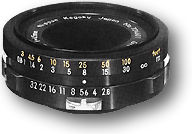
45mm f/2.8 GN Auto Nikkor(1969) |
With any ordinary lens, aperture size must be changed for each different shooting distance with flashbulbs or non-automatic mode in an electronic flash. You must also calculate aperture size for each shooting distance, using the guide number equation with the flash unit that you are using. Before the popularity of the automatic feature in an electronic flash, these calculations for precise f-number can be troublesome. The GN Nikkor has a control that set for the guide number of the type of flashbulb or non-auto flash you are using. After setting is done - you just focus. By presetting the flash guide number on the lens GN (guide number) scale from 10 to 30 in meters and 32 to 250 in feet, the lens diaphragm is coupled to the focusing ring. This automatically adjusts (stops down or opens up) the aperture in relation to the focusing distance, assuring correct flash exposure at all subject distances. This frees the photographer from the trouble of calculating the correct aperture and readjusting the lens diaphragm. What if you are not using a flash ? When the GN control is disconnected, the lens acts like an ordinary compact standard lens. By disengaging the GN coupling device, the lens can be coupled with camera exposure meters for full aperture exposure measurement and used as an ordinary normal lens. The 7-bladed polygonal diaphragm, designed to form an almost circular aperture around the most commonly used f/8 setting, reduces the effects of light diffraction to the minimum. It can be stopped down to f/32. Light and compact, the lens weighs only 150g (5.3 oz) and protrudes only 20mm (3/4 in.) from the camera body.
This lens
was introduced in 1969. Canon has a similar solution in their CAT flash system first seen on
their top of the line Canon F1 in 1971. The main
advantage of the CAT system is - the coupler enables the semi-auto flash system works
on many of their FD lenses instead of one as the GN Nikkor here. Anyway, neither
of the companies pursued further in their respective development because the features
found in an automatic flash are more convenient and easier to handle and the GN Nikkor
solely represents a stage of development in the history of Nikon SLR development
and has never seen any upgrades. Anyway, during those days, when used in combination
with the Nikon Speedlight Unit, the GN Nikkor lens is particularly effective for
capturing a moving subject or for candids where the photographer has no time to reset
the diaphragm. The GN Auto Nikkor may also be used as a substitute for a normal lens
for general photography. Its picture angle of 50° makes the lens valuable for
landscapes or indoor group photographs and remains as the most compact and lightweight
of all the Nikkor lenses.
 18k (Jpeg) |
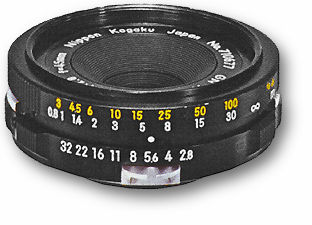
The distance scale and guide-number scales are engraved in yellow (feet) and white (meters). In combination with an extension ring or a bellows, this lens is also highly effective for close-up photography because it has relatively little image deterioration even in high magnification ranges. |
 |
Specifications: |
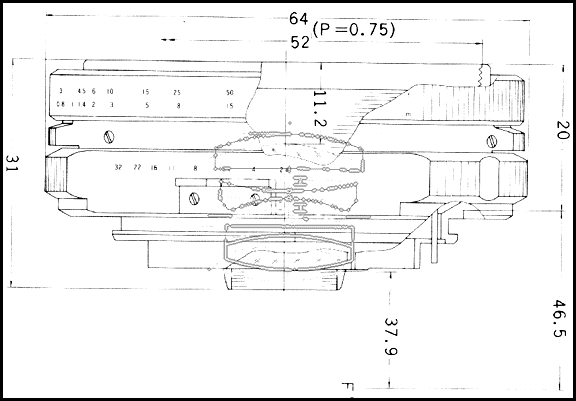
Dimensions: 64mm dia. X 31 mm length (2-17/32 in. X 1-7/32 in.)
Weight: 150g (5.3 oz)
Accessories: 52mm snap-on front cap (108 - 00 - 400), rear cap type F ( 108 - 00 - 401), 52mm screw-in lens hood (108 - 03 - 200), plastic case type S (108 - 00 - 300); flexible pouch No. 51 (108 - 00 - 302) Although it may not be applicable anymore but Product Code No.for this lens: 108-03-111
| Message Board |
for your
Nikkor
Optics
in a shared environment
| Message Board | Specifically for Dispose or Looking for new/used Nikon/Nikkor photographic equipment
 |
Nippon Kogaku Rangefinder Resources | Nikon F | Nikon F2 | Nikon F3 | Nikon F4 | Nikon F5 | Nikon F6 | Nikkormat / Nikomat | Nikon FM Series | Nikon FE/ FA | Nikon EM/FG/FG20 | Nikon Digital SLRs | Nikon - Other models |
Nikon MF RF-Nikkor lenses for Rangefinder
cameras:-
Main Index Page
Nikon
Auto Focus Nikkor lenses:- Main
Index Page
Nikon
Manual
Focus
Nikkor lenses:-
Fisheye-Nikkor Lenses - Circular |
Full Frame |
Ultrawides Lenses - 13mm15mm18mm20mm |
Wideangle Lenses - 24mm28mm35mm |
Standard Lenses - 45mm 50mm 58mm | Telephoto Lenses
- 85mm105mm135mm180mm & 200mm |
Super-Telephoto Lenses - 300mm 400mm 500mm 600mm 800mm 1200mm |
 |
Special Application
lenses: Micro-Nikkor Lenses - 50mm~55mm -60mm 85mm -105mm 200mm Micro-Zoom 70-180mm Perspective Control (PC) - 28mm 35mm PC-Micro 85mm Dedicated Lenses for Nikon F3AF: AF 80mm f/2.8 | AF 200mm f/3.5 EDIF Depth of Field Control (DC): 105mm 135mm Medical Nikkor: 120mm 200mm Reflex-Nikkor Lenses - 500mm 1000mm 2000mm Others: Noct Nikkor | OP-Nikkor | UV Nikkor 55mm 105mm | Focusing Units | Bellows-Nikkor 105mm 135mm Nikon Series E Lenses: 28mm35mm50mm100mm135mm | E-Series Zoom lenses: 36~72mm75~150mm70~210mm |
MF Zoom-Nikkor Lenses: 25~50mm | 28~45mm | 28~50mm | 28~85mm | 35~70mm | 36~72mm E | 35~85mm | 35~105mm | 35~135mm | 35~200mm | 43~86mm | 50~135mm | 50~300mm | 70~210mm E | 75~150mm E | 80~200mm | 85~250mm | 100~300mm | 180~600mm | 200~400mm | 200~600mm | 360~1200mm | 1200~1700mm
Tele-Converters: TC-1 | TC-2 | TC-200 | TC-201 | TC-300 | TC-301 | TC-14 | TC-14A | TC-14B | TC-14C | TC-14E | TC-16 | TC-16A | TC-20E
Recommended links to understand more technical details
related to the Nikkor F-mount and production Serial Number:
http://rick_oleson.tripod.com/index-153.html by: my
friend, Rick Oleson
http://www.zi.ku.dk/personal/lhhansen/photo/fmount.htm by: Hansen,
Lars Holst
http://www.mir.com.my/rb/photography/hardwares/nikonfmount/lens2.htm
http://www.photosynthesis.co.nz/nikon/serialno.html
Recommended Reading Reference on Nikon cameras and Nikkor lenses | about this photographic web site
 |
| Back | Main Index Page of Nikkor Resources | Back | Main Index Page of Pictorial History of Nikon SLRs |
 |
Home - Photography in Malaysia |
 Co-developed
with my web buddy, Rick Oleson® &
Co-developed
with my web buddy, Rick Oleson® &  Denmark, Creator of the Nikon
Repair Group Mailing-List;
A
contributing effort to Michael Liu's Classic Nikon SLRs and
Nikkor optic site.
Denmark, Creator of the Nikon
Repair Group Mailing-List;
A
contributing effort to Michael Liu's Classic Nikon SLRs and
Nikkor optic site.
Credit: MCLau®, who has helped to rewrite
some of the content appeared this site. Chuck Hester® who has been helping
me all along with the development of all these Nikon websites; Lars Holst Hansen, 'Hawkeye'
who shares the same passion I have; Ms Rissa, Sales manager
from Nikon Corporation Malaysia for granting permission to use some of the official
content; Ted Wengelaar, Holland
who
has helped to provide many useful input relating to older Nikkor lenses; Some of the references
on production serial numbers used in this site were extracted from Roland Vink's website; Hiura Shinsaku from Nikomat
Club Japan. Lastly,
to all the good people who has contributed their own expeience, resources or kind
enough granted permission to use their images of their respective optic in this site.
It is also a site to remember a long
lost friend
on the Net. Note:certain content and
images appeared in this site were either scanned from official marketing leaflets
& brochures published by Nikon and/or contribution from surfers who claimed originality
of their work for educational purposes. The creator of the site will not be responsible
for may discrepancies arise from such dispute except rectifying them after verification. "Nikon", "Nikkormat", "Nippon Kokagu
KK"
& "Nikkor" are registered
tradename of Nikon Corporation Inc., Japan. Site made with an Apple IMac.