|
|
Additional
information on
|
|
Nikon (Nippon
Kogaku K.K.) accessories Group
Lens hoods and Lens / body caps for Nikon Rangefinder (RF) cameras/lenses
|
HTML File Size: 32k Loading ...
While body and lens caps all serve only one purpose
to protect the camera body and lens, as well as preventing from possible penetration
of foreign particles which may in time, may degrade the performance; lens hoods on
the other hand, also serves to protect the exposed front optical element and its
other main purpose is to avoid unintended light invasion. Lens surfaces, when there
is another projecting light source hits directly onto the surface, may create internal
reflection which in turn may result in flare and it could affect or degrade the optical
quality of the photo taking lens. stray light can be in many forms, one of the most
encountered situation is with intended backlit photography such as portraiture. Long
extension of lens hood can minimize the chances of letting stray light from hitting
directly on the front lens element. However, generally, the wider the picture angle
of the lens is, the shallower should be with the depth of the lens hood and they
may yield varying degree of results. To many photographers, this may seem to be an
indefensible accessory but most can live without it. Nikon had been offering many
lens hood since the rangefinder Nikon days. They came with various design and choice
of materials. Early versions of Nikon lens hood were mostly in chrome design. Although
one way or another, internal section of the lens hood are usually painted in black
to serve its purpose, later models were all made in black and chrome hoods were offered
as optional request to match the lens type or versions.
Similarly, body and lens caps had also went through similar development path. With
all chrome models as the early version, black as updated models and towards the end
of the rangefinder system, some versions actually were produced in plastic only.
It would be safe to conclude the first few years after Nikon had began producing
their own bayonet mount S-series, the front/rear lens caps and lens hood for the
Nikkor lenses were all produced in chrome based only. |
 |
Part 1:- Brief discussion on Nikon Lens / Body Caps in the Rangefinder
System
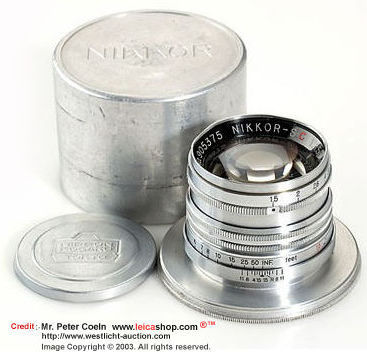
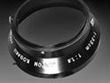
Earliest as the photo shown at left could have been engraved with a "NIKKOR"
name in old type of font face. These were mainly made in occupation ("MIOJ")
period. As these basic accessories couldn't be produced in large quantity in accordance
to the number of lenses sold.
 |
No one can provide assuring timing when did Nikon
shifted the early "NIKKOR" engraved design to "Nippon Kogaku
Tokyo" but a rough guess these should be happened around the timing between
1950-1952. The early change was also believed to had been using chrome caps and hood
except they are more refined with the new emblem on.
|
|
 |
|
This is the type of chrome lens hood for an early
series of Nikkor-Q 135mm f/4.0 telephoto lens in Nikon rangefinder days with an old
" Nippon Kogagu Tokyo" logo at the front. It replaced the first series
with a large "NIKKOR" word at the front, the same with the version shown
at top left ahnd corner. Generally, a vintage, all chrome/brass rangefinder Nikkor
lenses is best matched with a chrome lens hood such this this, regardless ffrom the
perspective of oldie collection and/or showcase purpose as it reflects an overall
antigue old look of a produce 50 years ago.
Credit: Image of the 13.5cm
front lens cap courtesy of Mr. ALI from mbenze-s600@Ebay
Store.
All images Copyright © 2008. All rights reserved. The chrome lens keeper, front
lens cap for the Nikkor-S.C 5cm f/1.5
shown above courtesy of
Mr. Peter Coeln from LEICA
Shop®, Austria who also operates a popular
Westlicht Auction House. Image Copyright © 2008. All rights reserved. Please respect
the visual property of the contributing photographer. |
 |
 |
| OFF TOPIC:- This certainly looks like an old, rare
version of a Nikon RF camera caps huh ? No. it is just a bubble case but it was made
in rare and unique form in solid black finishes to serve an early Nikkor-S 1:1.5 f=8.5cm telephoto lens in Leica screw mount that was started to offer during 1951.
It carries with few of the earliest series of old Nikkor lens accessory features
and considered as an odd offer during such a late MIOJ stage. |
 |
NOTE:- Earliest lens cap designs were
at at 1st row. Mid stage Nikon rangefinder period models were at the 2nd row with
5cm f/1.1 at the far left. The 3rd ~5th caps at the last row are the late models,
closer to reflex F design. The center (3rd cap at last row) was a S4 cap. The body
cap has two basic designs (1st/2nd) 3rd row.
|
| |
|
Credit: A composite photo
of various Nikon caps of different stages was scanned and retouched from Nikon RF
Magazine Photographer:  ® Image copyright
2000 Skogakukan, 2000, Japan. ® Image copyright
2000 Skogakukan, 2000, Japan. |
 |
The above can be a good reference guide to get a rough
idea of various stages of lens cap designs which were actually in accordance to the
development of rangefinder Nikkor lenses. The scanned works was less than desirable
but basically, it can be separated into screw-in, slip on to clip on with a double
spring design. The rear caps are more straight forward except after the plain chrome
model, they have resorted to two different designs with only the differences in the
embossed emblem and lettering used. I will try to search my library to see if I have
all these to show you in a clearer and more detailed views....as the difference in
lens focal length may resulted in more variations of these caps and even extended
to the lens hoods design.
Below were an original Nikon made front and rear lens body caps used on an old version
of Nikkor-Q
1:4 f=13.5cm telephoto lens that
was first introduced in 1948 but the earliest version was not the same as shown below,.
Typically, earliest design has the same with the 8.5cm as shown above with a big
"NIKKOR" word and was produced in chrome only.
|
 |
 |
So, the version here could fall as the 2nd design
of the series. All these can be a good indicative samples reflecting the progressive
development. The usual position of the MIOJ mark was stamped on the reverse side
of the Snap-On cap (see below).
|
 |
The above can be a good reference guide to get a rough
idea of various stages of lens cap designs which were actually in accordance to the
development of rangefinder Nikkor lenses. The scanned works was less than desirable
but basically, it can be separated into screw-in, slip on to clip on with a double
spring design. The rear caps are more straight forward except after the plain chrome
model, they have resorted to two different designs with only the differences in the
embossed emblem and lettering used. I will try to search my library to see if I have
all these to show you in a clearer and more detailed views....as the difference in
lens focal length may resulted in more variations of these caps were being offered
along with both camera/lenses and even extended to affect the lens hoods design.
Whatever, the caps appeared during this stage still were metal. They are generally
solid and rigidly made and is hard to find in recent years of offers.
<<<--- The slightly reflective surface in the backlight
of the few photos here have well-illustrated the change during the next course of
design used in the Nikon camera/lens caps.
|
 |
 |
Two followed up lens/body caps in stamp-in
and embossed Nippon Kogaku Tokyo emblem.

Above:- Ridged edge metal-type caps with
embossed Nippon Kogaku Tokyo Emblem. Note the difference s in each of them from screw-in,
clip-on and Snap-On type.
<<<--- Embossed type Nippon Kogaku Tokyo cap.
|
 |
 |
The Nikkor-S.C f=5cm 1:1.1 standard
lens has always being a charm within many lenses found in the rangefinder Nikkor
lens group. It has an incredible large aperture of f/1.1 - which makes it the fastest
lens Nikon had ever produced! And this is the one and one Nikkor with such a fast
lens speed.
|
Due to its extraordinary light gathering power, it
has an unusual large diameter and Nikon had designed a 62mm filter attachment size
- it was also the largest filter thread within the RF Nikkor lens group that doesn't
require Nikon
Reflex Housing. I.e. long telephoto
lens group.
The front lens cap of this
INTERNAL mount version of the fast Nikkor-S.C 50/1.1 standard lens was still carrying
the old "Nippon Kogaku Tokyo" emblem (Compare this with the "Nikon"
model below). As the lens itself was only being introduced after 1956, the front
cap was already adopting the Snap-On design with two metal catches at each end. The
rear cap has a rather lengthy dimension so as to host the elongated rear section
of the lens tube. The mount-on index is not colored in this version, but that is
not so significant. |
| |
|
 |
 |
| As shown, the late version of the Nikkor-S.C 1:1.1 f=5cm uses a different lens cap with a "Nikon" and
the texture was different from earlier model but it still shares common 62mm diameter.
It uses the spring catch design as used on many of the early non-Ai series of reflex
F-mount lenses after 1959. Further, material use is a plastic. |
| |
|
 |
 |
| Similarly, the front lens cap of this
1956's 48mm W.Nikkor 1:1.8 f=3.5cm fast speed wideangle lens was also having a new
Nikon plastic Snap-On catch design (Notice both were marked with "Patent Pending"
inscription. The rear cap has an interesting "WW" which I am not sure what
the hell does this represents (anyone knows ?) It has a typical second followed up
design of rear cap. |
| |
|
 |

This was the front and rear lens cap supplied along
with a late model Nikkor-T
1:4 f=10.5cm w/preset mechanism,
a version we know was introduced during the late '50. It uses the same front cap
but it has a different flat and plain rear cap which was colored in the lens mounting
index. So, don't be so conclusive to use the caps as indicative trend to judge the
year of produce.
NOTE: I do not entirely write off the possibility
of the showcased sale item here where the seller may match a different kind of cap(s)
from the original offering that came along with the lens package. So, I would rather
be opened rather than conclusively basing on a photo of a recent auctioned item to
make any final remark and always remember, there could be other variations.
<<<-- See an example of a unknown version of a front lens
cap used for the Leica Screw Mount (LSM) W.Nikkor-C 2.5cm f/4.0
|
 |
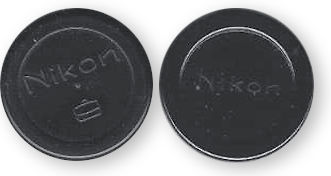
Among the 5cm lens group with the common f/1.4 maximum
aperture, this Nikkor-S 1:1.4 f=50mm was termed as "OLYMPIC" by collectors.
Produced between 1962~1964 which was coincided with the Tokyo Olympic 1964. The model
shown here uses the same rear cap but the front lens cap had eliminated the metal
catches and only uses the plastic spring. This could well be a good representing
model of the accessories of lens caps offered by Nikon at the end of rangefinder
period.
|
 |
|
|
|
An odd color lens cap in green with
old NK Japan embossed emblem.
|
This is not a lens cap, but the
front and rear section of the film magazine offered during MIOJ period, Notice the
old type face used ?
|
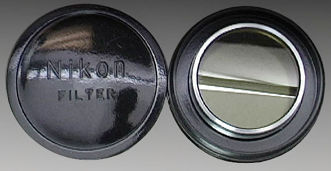
Similarly, the early MIOJ filter
has a nice container which share the same design as with the old MIOJ period film
magazines (left).
|
| NEXT | 1/2
Various lens hoods designs /
versions offered by Nikon (Nippon Kogaku KK) for RF (rangefinder) system
| |
|
|

|

|
|

|
 |
 |

|
|
Fixed fens Finders
|
Variframe/Varifocal
|
Sports Finder
|
Lens Hoods
|
Reflex Housing
|
close-up
|
Motor Drive
|
Miscellaneous
|
|
|
| |
|
Fixed
Focal length Finders | Variframe / Varifocal / Sports Finders | Reflex Housing | Motor
Drive S36
Manual | Close-ups | Nikon RF Flash System
Accessories: Lens caps, Hoods/shades, Cases/Compartments, Filters, Packing/boxes, &
Others | Instruction Manuals | Original Price Lists
|
|
| |
W-Nikkor-O
1:4 f=2.1cm | W-Nikkor.C 1:4 f=2.5cm | W-Nikkor.C
1:3.5 f= 2.8cm | W-Nikkor.C 3.5cm lens Group (3.5/2.5/1.8) | Stereo-Nikkor 1:3.5 f=3.5cm | 5cm (50mm) lens group | RF Micro-Nikkor
1:3.5 f=5cm | Nikkor-P.C
1:2 f=8.5cm lens group / Nikkor-S.C 1:1.5 f=8.5cm lens group | Nikkor-P.C
1:2.5 f=10.5cm lens group
/ Nikkor-T 1:4 f=10.5cm | Nikkor-Q.C 13.5cm lens group: 135/4, 135/3.5
Early / Last Version,
135/4 Bellow
lens | Nikkor-H 1:2.5 f=18cm | Nikkor-Q 1:4 f=25cm | Nikkor-T 1:4.5 f=35cm | Nikkor-T.C 1:5 f=50cm | Reflex-Nikkor 100cm f/6.3
System Accessories
for Nikon Rangefinder cameras
Nikon Reflex
Housing | Nikon S36/S72/S250 Motor Drives / S36 Manual |
light meters | Nikon RF Flash/Speedlights | Close-up photography
/ Repro Copy Outfit / Nikon Bellow Focusing Device (in progress) | Cases/Compartments | Lens & body caps, Lens Hoods/shades,
Original Price
Lists | packaging/boxes
RELATIVE:-
Nikon Rangefinder (RF) Models | Pictorial History of Nikon |
A small visual library on Nikon
Ultra-Micro-Nikkor lenses
Manual Focus Nikkor lenses | Autofocus
Nikkor lenses
For other issues, you may use the relevant
| Message Board | lenses | Relative:- | Message Board | Rangefinder
cameras
|
| |
|

|
|
|
|
|


| Credit:- Co-developed with Rick_Oleson. THANKS to all the contributors in the
form of images/pictures as well as content which made up the basis of this RF Nikkor
site. Picture used at this startup page courtesy of Photo_Arsenal-Worldwide® Germany. Image(s) copyright © 2008. All rights reserved. Please
respect the visual property of the contributing photographer. Note: Certain content
and images appeared in this site were either scanned from official marketing leaflets,
brochures, sales manuals or publications published by Nikon over the years and/or
contributions from surfers who claimed originality of their work for educational
purposes. The creator of the site will not be responsible for any discrepancies that
may arise from dispute except rectifying them after verification."Nikon",
"Nikkormat", "Nippon Kokagu KK" & "Nikkor" are
registered trade names of Nikon Corporation Inc., Japan. Site made with an Apple
G5 IMac. |
|
